

Explore more psychological storytelling, character analysis and thriller recommendations in our Psychological Thriller Books & Insights Hub.
Also: Discover your psychological reading type and find the thrillers that match your mind.
- Unreliable narrator books: when the person telling the story may not be telling the truth
- Unreliable narrator books create psychological tension
- Unreliable narrator books explore human self-deception
- Gone Girl
- The Silent Patient
- The Last Mrs Parrish
- The Girl on the Train
- Before I Go to Sleep
- The Talented Mr. Ripley
- You
- The Woman in the Window
- Shutter Island
- How unreliable narrator books connect with the shadow side of human nature
- If you enjoy unreliable narrator books and psychological character studies…
- If you enjoy dark secrets and hidden motivations…
- If you enjoy exploring the darker side of the human mind…
- What are unreliable narrator books?
- Why do readers enjoy unreliable narrator books?
- Is Gone Girl an unreliable narrator book?
- Are psychological thriller books usually written with unreliable narrators?
- What makes a good unreliable narrator?
- What should I read after enjoying unreliable narrator books?
Unreliable narrator books: when the person telling the story may not be telling the truth

What if the person guiding you through a story is hiding something?
What if the memories they describe are incomplete? What if the details they leave out are more important than the ones they reveal? What if the biggest mystery is not what happened — but whether you can trust the person telling you?
That is the power of unreliable narrator books.
These are the stories that turn readers into detectives. Instead of simply following the plot, you begin analysing every conversation, questioning every motive and searching for the truth hidden beneath the surface.
The unreliable narrator is one of the most fascinating devices in psychological thrillers because it explores something deeply human: our relationship with truth.
People do not always see themselves clearly. We justify our choices. We protect ourselves from painful realities. We remember events differently. Sometimes we hide things from others. Sometimes we hide things from ourselves.
“The best psychological thrillers do not just hide the truth. They make you question whether you ever understood it.”
The best unreliable narrator books take these ordinary human experiences and transform them into unforgettable psychological journeys.
They ask:
- Can we trust someone who cannot even trust themselves?
- How much of reality is shaped by perception?
- What happens when the person telling the story is also the person we should fear?
For readers who love psychological thrillers, mystery novels and suspense stories filled with twists, unreliable narrators offer something unique: the feeling that the entire story could change at any moment.
Love psychological stories that explore secrets, manipulation and human behaviour?
Discover what your thriller reading style says about you with our free Psychological Reader Types Guide.
What are unreliable narrator books?
An unreliable narrator book is a story where the narrator’s version of events cannot be fully trusted.
This does not always mean the narrator is deliberately lying.
An unreliable narrator may:
- intentionally deceive the reader
- hide important information
- misunderstand what is happening
- remember events incorrectly
- justify harmful behaviour
- present themselves in a way that creates sympathy
- fail to understand their own motivations
The key idea is uncertainty.
The reader is forced to ask:
“Am I being told the truth?”
Unlike traditional storytelling, where the narrator acts as a guide, unreliable narrator books create doubt between the reader and the story.
That uncertainty is what makes them so addictive.
You are no longer just reading a story.
You are investigating one.
Why unreliable narrator books are so addictive
The popularity of unreliable narrator books comes down to something deeper than surprise endings.
Readers are fascinated by the psychology behind why people hide, distort and protect parts of themselves.
A great psychological thriller does not just ask:
“Who committed the crime?”
It asks:
“Why would someone do this?”
And often:
“What are they refusing to admit?”
Unreliable narrator books create psychological tension
Traditional mysteries often create suspense by hiding information from the reader.
Unreliable narrator books create tension in a different way.
They make the reader question the information itself.
Every detail becomes important.
A strange reaction.
A missing memory.
A character avoiding a particular topic.
A sentence that feels slightly wrong.
Readers become active participants because they cannot simply accept what they are being told.
They have to interpret.
They have to analyse.
They have to decide what is real.
This is why psychological thrillers can feel so personal. They do not just challenge your ability to solve a mystery.
They challenge your ability to understand another person.
Unreliable narrator books explore human self-deception
One of the most interesting parts of unreliable narrators is that they often reflect something true about human behaviour.
Most people like to believe they are objective.
But humans constantly interpret reality through their own experiences, fears and beliefs.
Someone may genuinely believe they are telling the truth while still presenting a distorted version of events.
Read more here: Why Psychological Thrillers Are So Addictive: The Psychology Behind Our Obsession
A character might:
- minimise their own actions
- blame others for their choices
- rewrite painful memories
- convince themselves they are the victim
- avoid confronting uncomfortable truths
This is what makes psychological thrillers so compelling.
The danger is not always an obvious villain.
Sometimes the danger is someone’s inability to see themselves honestly.
“The most frightening characters are not always the ones who hide the truth from others. Sometimes they are the ones who hide it from themselves.”
The different types of unreliable narrator books
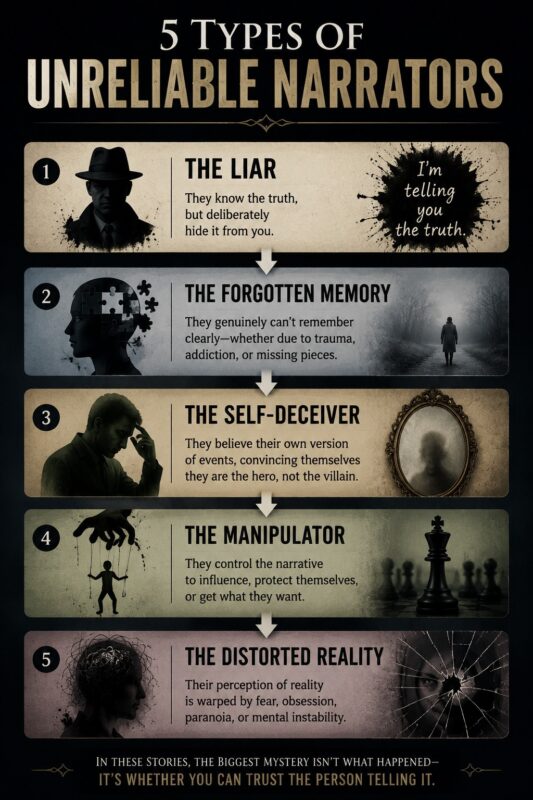
Not every unreliable narrator works in the same way.
Some characters manipulate.
Some are confused.
Some are damaged.
Some are trying to understand what happened themselves.
Understanding these different types can help you discover the psychological thrillers that match your reading style.
1. The deliberate liar: unreliable narrator books where someone is hiding the truth
The deliberate liar is one of the most recognisable types of unreliable narrator.
This character knows more than they reveal.
They may manipulate other characters, the reader, or even the entire situation around them.
The enjoyment comes from slowly uncovering the gap between:
what they say happened
and
what actually happened.
These narrators create a fascinating psychological battle between the character and the reader.
You begin asking:
- Why are they lying?
- What are they protecting?
- What happens when the truth comes out?
A famous example is Gone Girl, where readers are forced to question the reliability, motivations and morality of the characters.
If you enjoy psychological manipulation, morally complex characters and stories where appearances are deceptive, this type of unreliable narrator is often the most satisfying.
2. The unreliable memory narrator: when the past cannot be trusted
Some unreliable narrator books focus on memory.
The narrator is not necessarily trying to deceive anyone.
They genuinely do not know the complete truth.
Memory can be complicated.
People forget details.
People reinterpret experiences.
Trauma can affect how events are remembered.
This creates a unique type of mystery because the narrator is searching for answers alongside the reader.
Examples often explore:
- missing time
- forgotten events
- trauma
- secrets from the past
- conflicting memories
A popular example is The Girl on the Train, which explores perception, memory and the danger of assuming we understand someone else’s life.
These stories appeal to readers who love psychological depth more than straightforward crime-solving.
3. The morally compromised narrator: when the truth is complicated
Some unreliable narrator books feature characters who are technically telling the truth — but hiding their responsibility.
These characters are fascinating because they are not simply “good” or “bad”.
They may reveal events honestly while carefully avoiding their own guilt.
They might say:
“I did what I had to do.”
But the reader begins asking:
“Did you really?”
This type of narrator explores one of the most interesting areas of human psychology:
How do people justify their own actions?
A classic example is The Talented Mr. Ripley, which explores identity, ambition and deception.
“The most dangerous stories are sometimes told by people who believe they are telling the truth.”
4. The distorted reality narrator: when perception becomes the mystery
Some unreliable narrator books challenge the reader’s understanding of reality itself.
The narrator’s perception may be affected by:
- fear
- obsession
- paranoia
- trauma
- mental health struggles
- intense emotional experiences
The question becomes:
Is the narrator uncovering something?
Or are they creating it?
These stories often create some of the most memorable psychological experiences because the reader feels trapped inside the character’s perspective.
5. The confessional narrator: when someone tells you their story for a reason
Confessional narrators are especially powerful because the reader becomes the person receiving the confession.
But why are they telling you?
Are they seeking forgiveness?
Attention?
Sympathy?
Control?
A confession is never just information.
It is communication with a purpose.
The narrator may want you to understand them.
But they may also want to influence how you judge them.
This creates one of the most interesting questions in psychological thriller books:
Can someone reveal the truth while still manipulating you?
Why readers are fascinated by unreliable narrator books
The best unreliable narrator books are not memorable because they simply contain a twist.
A twist is temporary.
What stays with readers is the psychological question underneath:
“Could someone really see themselves this differently?”
These stories appeal to something deeply human — our curiosity about what happens inside another person’s mind.
We are fascinated by:
- secrets people keep
- the parts of themselves they hide
- the stories they tell to survive
- the difference between intention and impact
- whether people truly know themselves
This is why psychological thrillers continue to attract readers around the world.
The crime or mystery may draw you in, but the psychology keeps you turning pages.
Unreliable narrator books reveal the psychology of self-deception
One of the reasons unreliable narrator books feel so realistic is because they reflect a truth about human behaviour:
People rarely see themselves exactly as others see them.
Everyone has a personal story about who they are.
A person might believe:
“I am the victim.”
“I had no choice.”
“I was protecting someone.”
“I was doing the right thing.”
But another person experiencing the same event may tell a completely different story.
This gap between perception and reality is where psychological thrillers thrive.
The most compelling unreliable narrators are not cartoon villains.
They are people who feel real.
They have fears.
They have desires.
They have wounds.
They have reasons.
And that is what makes them unsettling.
Because the most frightening question is often not:
“What are monsters capable of?”
It is:
“What are ordinary people capable of when they are protecting the story they tell themselves?”
“A great psychological thriller does not just reveal secrets. It reveals the reasons people hide them.”
Unreliable narrator books and the power of perspective
Every story is shaped by perspective.
Two people can experience the same moment and walk away with completely different versions of what happened.
Unreliable narrators take this everyday human experience and make it the foundation of the story.
They remind us that:
- memory is imperfect
- emotions influence judgement
- fear changes perception
- people interpret events through their own experiences
This is why these books often stay with readers long after the final page.
They do not just entertain.
They make you question how well you understand other people.
And sometimes, how well you understand yourself.
“A great unreliable narrator does not fool the reader. They reveal how easily humans can fool themselves.”
The best unreliable narrator books for different types of thriller readers
Not every thriller reader loves the same kind of psychological mystery.
Some readers want shocking twists.
Others want complex characters.
Some love dark moral questions.
Others want stories that make them question reality itself.
Here are some of the best unreliable narrator books based on the experience you are looking for.
If you love psychological manipulation: choose unreliable narrator books that play mind games
These stories are perfect for readers who enjoy:
- manipulation
- characters with secrets
- changing perspectives
- shocking reveals
Recommended reads:
Gone Girl
A defining psychological thriller about marriage, identity and deception.
It challenges readers to question whether they understand the people closest to them.
I wrote more in this article: Books Like Gone Girl: Best Psychological Thrillers About Betrayal & Lies
The Silent Patient
A psychological mystery built around silence, trauma and the search for truth.
Perfect for readers who enjoy questioning every character’s motivation.
I wrote more in this article: Books Like The Silent Patient: Psychological Thrillers You Won’t Be Able to Put Down
The Last Mrs Parrish
A story about ambition, identity and the dangerous consequences of wanting someone else’s life.
If you love unreliable narrator books about memory and perception
These books appeal to readers who enjoy:
- missing information
- unreliable memories
- psychological vulnerability
- uncovering the past
Recommended reads:
The Girl on the Train
A story where memory, perception and addiction influence how the truth is uncovered.
Before I Go to Sleep
A gripping exploration of identity and memory where the narrator must question what she knows about herself.
If you love dark characters and morally complex stories
Some of the best unreliable narrator books focus less on solving a mystery and more on understanding a person.
These are stories where the character themselves becomes the puzzle.
Recommended reads:
The Talented Mr. Ripley
A psychological classic exploring identity, obsession and deception.
You
A disturbing exploration of obsession and self-justification from a narrator who believes he understands love.
If you love stories where reality itself feels uncertain
These unreliable narrator books create a feeling of unease.
They make readers question:
- what is real?
- what is imagined?
Recommended reads:
The Woman in the Window
A psychological thriller built around isolation, observation and uncertainty.
Shutter Island
A story that explores perception, identity and the difficulty of separating truth from illusion.
What makes a great unreliable narrator book?
A successful unreliable narrator is not simply a character who lies.
A poor unreliable narrator feels like the author is trying to trick the reader.
A great unreliable narrator feels psychologically believable.
The reader should finish the story thinking:
“I should have seen it.”
Not:
“The author hid information unfairly.”
The strongest unreliable narrator books use several techniques.
1. Contradictions
Small inconsistencies create suspicion.
The narrator may say one thing but behave in a way that suggests something different.
Readers begin noticing the gaps.
2. Missing information
Sometimes what the narrator does not say matters more than what they do.
A silence.
An avoided topic.
A strange reaction.
These moments create curiosity.
3. Emotional truth
The narrator may not always provide factual truth.
But they often reveal emotional truth.
They show:
- fear
- insecurity
- obsession
- shame
- desire
That emotional honesty is what makes readers connect with even flawed characters.
4. A reason for unreliability
The best psychological thrillers understand that people do not distort reality randomly.
There is usually a reason.
Protection.
Fear.
Shame.
Love.
Survival.
The unreliability comes from being human.
The psychology behind why we love unreliable narrator books
The popularity of unreliable narrators connects with our natural desire to understand people.
Humans are constantly trying to answer questions like:
Why did they do that?
What are they really thinking?
Can I trust them?
What are they not telling me?
Psychological thrillers turn those questions into an experience.
They allow readers to explore the darker parts of human behaviour from a safe distance.
We can examine:
- obsession without being consumed by it
- manipulation without being trapped by it
- fear without being controlled by it
- secrets without carrying them ourselves
How unreliable narrator books connect with the shadow side of human nature
Many psychological thrillers explore what people prefer not to acknowledge about themselves.
The hidden parts.
The contradictions.
The impulses they try to suppress.
This is why stories about unreliable narrators often feel deeper than a simple crime mystery.
They explore the idea that everyone has complexity.
Everyone has things they hide.
The question is not whether people have darker sides.
The question is:
What happens when those hidden parts take control?
Find your psychological reading type and discover books matched to your mind.
Get the free Psychological Reader Types Guide and discover whether you are drawn to:
- psychological manipulation
- unreliable narrators
- dark character studies
- crime psychology
- atmospheric suspense
Why unreliable narrator books remain unforgettable
The reason these stories stay with us is because they challenge one of our strongest assumptions:
That we understand what we see.
But people are complicated.
Motives are complicated.
Memory is complicated.
Truth is complicated.
The most powerful psychological thrillers recognise this.
They do not simply ask:
“Who is lying?”
They ask:
“Why does someone need to lie?”
And that is often the much more interesting question.
Discover psychological thrillers inspired by real human behaviour
If you enjoy unreliable narrator books because you love exploring hidden motives, complicated characters and the psychology behind people’s choices, Roger Bray’s psychological thrillers explore similar themes.
Roger Bray’s stories focus on the darker questions behind human behaviour:
- What happens when secrets cannot stay buried?
- How far will people go to protect themselves?
- What happens when identity begins to unravel?
If you enjoy unreliable narrator books and psychological character studies…
Discover The Picture
A psychological thriller for readers who enjoy stories where appearances can be misleading and characters reveal unexpected layers.
If you enjoy dark secrets and hidden motivations…
Discover Hidden
Perfect for readers who enjoy suspense novels built around unanswered questions, human behaviour and the secrets people try to conceal.
If you enjoy exploring the darker side of the human mind…
Discover Blood Ribbon
A story for readers drawn to psychological tension, complex characters and emotionally intense crime fiction.
Are you ready to discover your next unreliable narrator book?
The best unreliable narrator books do something few other genres can achieve.
They make you question the story.
They make you question the characters.
And sometimes, they make you question your own assumptions about human behaviour.
That is why psychological thrillers remain so addictive.
The mystery is not only:
“What happened?”
The deeper question is:
“What does this reveal about who we really are?”
If you are drawn to stories about secrets, manipulation, identity, hidden motives and the complicated nature of people, you are already interested in the psychology behind the thriller.
Explore psychological thrillers where characters face secrets, impossible choices and the consequences of what people hide.
Because the most compelling stories are not always about what happened.
They are about why people do the things they do.
Frequently Asked Questions About Unreliable Narrator Books
What are unreliable narrator books?
Unreliable narrator books are stories where the narrator’s version of events cannot be completely trusted. The narrator may be hiding information, misunderstanding events, remembering incorrectly or presenting a distorted version of reality.
Why do readers enjoy unreliable narrator books?
Readers enjoy unreliable narrator books because they create psychological tension. Instead of simply following the story, readers become investigators, analysing characters, questioning motives and searching for hidden truths.
Is Gone Girl an unreliable narrator book?
Yes. Gone Girl is one of the most famous examples of an unreliable narrator book. It explores deception, perception, identity and the difference between appearance and reality.
Are psychological thriller books usually written with unreliable narrators?
Many psychological thriller books use unreliable narrators because the technique naturally creates suspense. It allows authors to explore memory, perception, trauma, manipulation and the hidden motivations behind human behaviour.
What makes a good unreliable narrator?
A good unreliable narrator feels psychologically realistic. Their unreliability should come from believable human experiences such as fear, shame, trauma, self-protection or personal bias rather than simply being a trick to surprise the reader.
What should I read after enjoying unreliable narrator books?
Readers who enjoy unreliable narrators often enjoy psychological thrillers, crime fiction books and suspense novels featuring complex characters, hidden motives and morally complicated choices.
Explore Roger Bray psychological thrillers inspired by real human behaviour, secrets and the choices people make when pushed to their limits. Sign up and get the free guide.