
The Story of Vanity: How Plastic Surgery Has Evolved Over the Centuries and Why Harold Gillies Is Still Echoing Through It.
There’s a strange discomfort that comes with looking at the extremes of human transformation. The vanity plastic surgery history isn’t just about medicine or aesthetics—it’s about identity, control, and what happens when people stop recognising themselves.

I read a story recently about a German woman, Martina Big, currently in the United States. She is known as a “glamour model”, though that word feels like it’s been stretched beyond recognition. Glamour used to suggest something magnetic, enchanting, almost cinematic.
What I saw felt like something else entirely.
And it raises a question that sits underneath much of modern culture:
At what point does self-expression become self-erasure?
If you’re interested in how human behaviour, identity, and obsession actually work beneath the surface, explore:
👉 Understanding Human Behaviour & Psychological Insight Hub
The Psychology Behind Vanity Plastic Surgery History
The vanity plastic surgery history is often framed as fashion, trends, or personal freedom. But underneath it, something more complicated is happening.
People don’t just change their bodies.
They try to rewrite how they exist inside the world.
And while it’s easy to judge, it’s harder to ignore the psychology:
- Identity instability
- External validation dependency
- Dissociation from self-image
- Cultural reinforcement of “upgrade culture”
- Deep emotional insecurity masked as control
None of this is simple. None of it is clean.
And yet, it plays out visibly on the body.
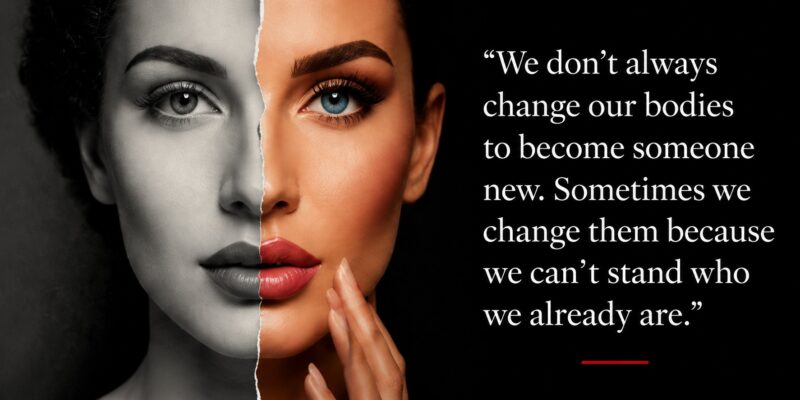
“We don’t always change our bodies to become someone new. Sometimes we change them because we can’t stand who we already are.”
Extreme Cases in Vanity Plastic Surgery History
Across the vanity plastic surgery history, there are cases that sit at the far end of the spectrum—where transformation stops being subtle and becomes identity reconstruction.
Some pursue repeated procedures, spending hundreds of thousands in pursuit of an idealised image. Others push into territory where biology itself starts to resist the changes.
It would be easy to laugh at it.
It would also be dishonest.
Because underneath it is often the same psychological driver:
a belief that the self is not enough.
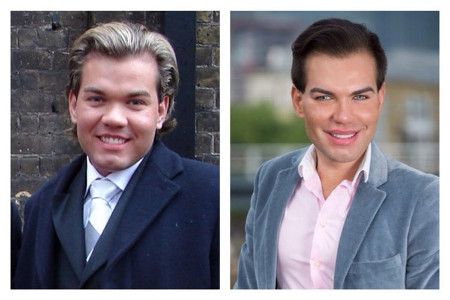
No more ridiculous than the guy who wants to look like Ken, Barbie’s friend with no benefits given his injection moulded, anatomical shortcomings. He has reportedly spent almost $600,000 and had more than 50 major cosmetic procedures to look like this.
It would all be hilarious if young pseudo Ken wasn’t suffering from necrosis and is in the situation that, given the multiple operations that he has had on his nose, he has damaged his olfactory member beyond repair and has left it with an uncertain fate, but possibly it turning black and falling off are in his future.

Some more desperate than others like the possibly psychologically challenged Pixi Fox who had six ribs removed to give herself the disproportionate waistline of her little plastic idol so she could be more like her. Also, looking at her ‘after’ picture I don’t recall my daughters’ Barbies having lips like a pugnacious duck but possibly my memory is playing tricks on me.
If pushed I would have to imagine that each of these people and the many thousands of others who do similar things, some even worse, to themselves have mental health issues.
There are many reasons, legitimate, understandable reasons for people to have plastic surgery. There are a lot of surgeons out there doing some brilliant re-constructive and life altering surgery. But what of the surgeons who carried out 10th, 20th or 30th unnecessary vanity operation on some of these people. What did the surgeon think when the budding Barbie wanted her ribs removed or Miss Big wanted help to turn herself into living, breathing facsimile of whatever the hell it is that she has become.
The Hippocratic Oath, which doesn’t, as often quoted, contain the phrase ‘First do no Harm’ does contain the phrase ‘I will utterly reject harm and mischief’ and an equivalent phrase from the Hippocratic School ‘…either help or do not harm the patient’. I have to wonder if these surgeons ever considered this oath, or at least its ideals. The harm done by these repeated and completely unnecessary procedures is obvious.
Then at the other end of the scale we have surgeons who do some absolutely brilliant work, from rebuilding bodies of the broken, burned or diseased to making bodies for people born with defects and missing parts.
The difference between these two worlds is startling
If stories like this make you think about why people behave the way they do under pressure, you may like:
👉 The Psychology of Identity Distortion and Emotional Collapse
Reconstructive Surgery vs Vanity Plastic Surgery History
Not all of the vanity plastic surgery history is about aesthetics.
At the other end of the spectrum sits reconstructive surgery—where the goal is not reinvention, but restoration.
Reconstructive surgery exists to:
- Restore function
- Repair trauma damage
- Rebuild after burns or disease
- Give people back what was lost
This is where medicine becomes something close to redemption.
And it’s here that the contrast becomes impossible to ignore.
Harold Gillies and the Origins of Modern Plastic Surgery
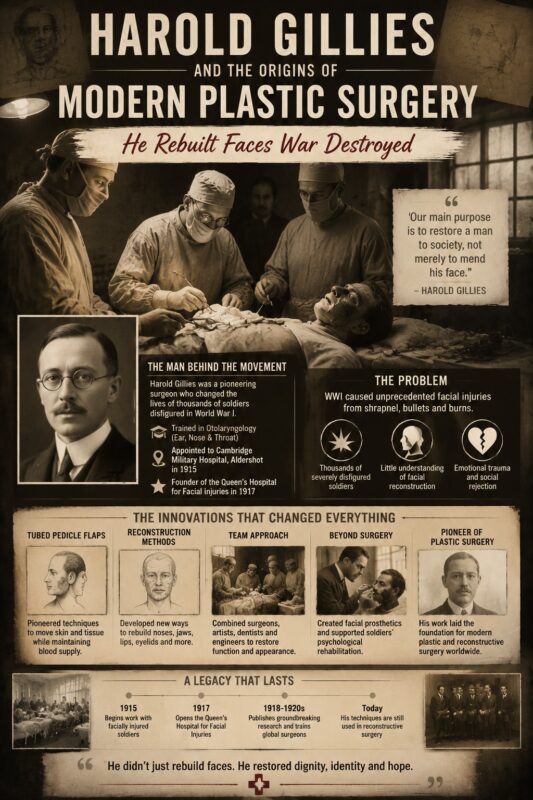
Harold Delf Gillies is one of the defining figures in the vanity plastic surgery history, though ironically his work had very little to do with vanity at all.
A pioneering surgeon during the First World War, Gillies was confronted with injuries that modern medicine had never seen at scale. Faces destroyed by shrapnel. Lives permanently altered in seconds.
He pushed for specialised facial reconstruction units when others hesitated. Entire hospitals were developed to treat thousands of wounded soldiers.
His work wasn’t about appearance.
It was about returning people to themselves.
And that distinction matters.
Because what Gillies created wasn’t cosmetic surgery as we often understand it today—it was survival.
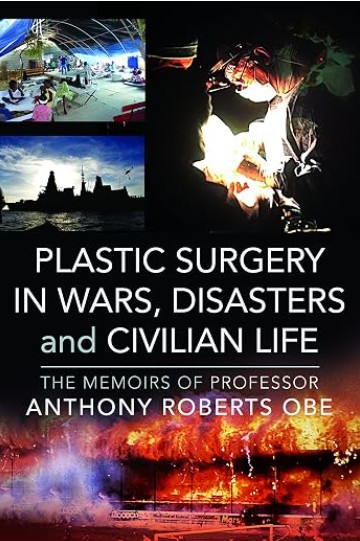
“The original purpose of plastic surgery was not to change faces. It was to give people their lives back.”
When Vanity Plastic Surgery History Diverges from Purpose
As the vanity plastic surgery history evolved, so did the motivations behind it.
What began as reconstruction gradually expanded into enhancement. Then into identity redesign. Then into something more cultural than medical.
This raises uncomfortable questions:
- When does treatment become indulgence?
- When does choice become compulsion?
- When does autonomy become harm?
These aren’t moral judgments. They’re psychological questions.
And they sit at the centre of modern human behaviour.
Real Stories That Sit Inside Vanity Plastic Surgery History
There are also stories that sit quietly beneath the noise.
People who survive trauma and rebuild their faces.
People who re-enter society after years of isolation.
People whose surgeries restore function, confidence, and dignity.
One world moves toward distortion.
The other moves toward repair.
And both exist inside the same medical field.
Why Vanity Plastic Surgery History Fascinates Us
The reason the vanity plastic surgery history continues to fascinate people isn’t because it’s shocking.
It’s because it reflects something uncomfortable:
We are all negotiating who we are.
And sometimes, that negotiation becomes visible.
Appearance is just the surface layer.
The real story is identity.
Roger Bray Book Recommendation:
If you’re drawn to the darker psychology behind identity, behaviour, and what people are capable of under pressure, you may enjoy Roger Bray’s psychological thrillers.
They explore:
- Human distortion under stress
- Moral collapse and justification
- Identity fracture
- Hidden motivations behind behaviour
👉 Explore Roger Bray Psychological Thrillers Inspired by Real Human Behaviour
If you enjoy exploring the psychology behind behaviour, identity, and the darker side of human decision-making, you can join our reader list.
👉 Get curated psychological thriller recommendations based on your reading style
👉 Early access to new releases
👉 Behavioural psychology insights behind real-life inspirationSign up: “Find your next psychological thriller based on your mind.”
Reconstructive Surgery, Vanity & Human Behaviour
The truth is that the vanity plastic surgery history isn’t really about surgery at all.
It’s about what people are trying to solve internally:
- Pain
- Identity confusion
- Social pressure
- Trauma
- Belonging
The body becomes the canvas.
But the story is always psychological.
FAQs
What is the history of vanity plastic surgery?
It evolved from reconstructive wartime surgery into modern cosmetic and aesthetic enhancement practices.
Who was Harold Gillies?
A pioneering WW1 surgeon who developed modern facial reconstructive surgery techniques.
What is the difference between reconstructive and cosmetic surgery?
Reconstructive surgery restores function and appearance after trauma; cosmetic surgery focuses on aesthetic change.
Why do people choose extreme plastic surgery?
Psychological factors include identity distress, trauma, validation seeking, and cultural beauty pressure.
Is plastic surgery psychological or physical?
It is both—physical change often reflects underlying psychological needs.
Can plastic surgery improve mental health?
In reconstructive cases, yes. In purely cosmetic cases, outcomes vary significantly.
History of plastic surgery in images:
Re-constructive surgery can be defined as the restoration of appearance and function following injury or disease, or the correction of congenital defects, using the techniques of plastic surgery.
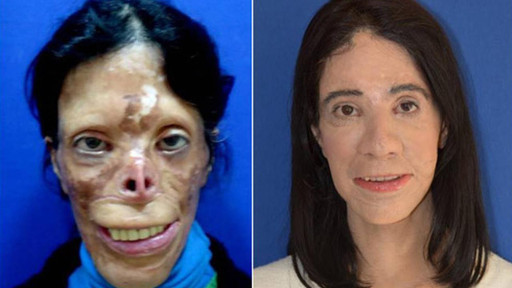
Asiye Engiz was only a year old when a fire swept through her home. She was rescued in time to save her life but had suffered horrendous burns. She spent the next 41 years in her house. No school, no social life, no self esteem, she never went out. Her family took her to a procession of doctors who all said that nothing could be done until, finally she was seen by Dr. Mehmet Mutaf. He was the first doctor who thought that her face could be rebuilt.
This wasn’t a face transplant but a complete reconstruction using cartilage and bone taken from her ribs, hair from her head for her eyebrows, skin tissue from her arm, fat from her body to shape her face and finally skin from her neck to make skin on her face. The results speak for themselves.
In a moment of drunken stupidity when he was 22 Richard Lee Norris managed to shoot himself in the face with a shotgun. For the next 15 years he lived as a recluse in his home town, only going out at night with his face covered with a mask. 5 years ago he underwent a face transplant and now relies on anti rejection drugs but is thriving.
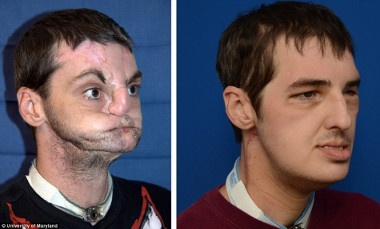
Two different people, two major re-constructive procedures but with one result, that their lives are an awful lot better than they were before.
Where does Harold Gillies come into this?
Harold Delf Gillies was a pioneering re-constructive surgeon treating the wounded from the First and Second World Wars. He joined Royal Army Medical Corps at the start of the First World War and was shocked by the injuries he saw in France and pushed the army set up their own plastic surgery unit.
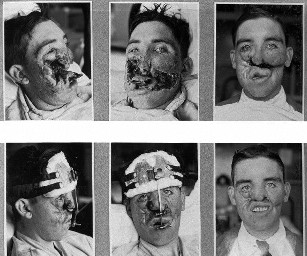
Soon after, a specifically-designed hospital was opened which treated 2,000 patients after the Battle of the Somme alone. Although Gillies was performing extraordinary work facial reconstruction was initially viewed with suspicion but became an integral part of the post-war healing process. One major issue for such invasive surgery was that this was in the time before antibiotics and the surgery was very risky.
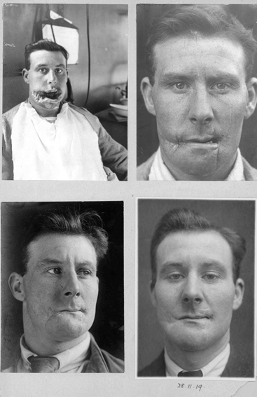
The pioneering work of Gillies and other surgeons not only save countless hundreds of lives but allowed many terribly injured men to re-enter society and help them cope with the psychological injuries they had suffered. He pushed the boundaries with his techniques and helped train new surgeons who took the skills even further through the Second World War.
All that work and all the selfless talent to see the popular media fixate on Miss Big and Miss Fox as some sort of poster for modern cosmetic surgery.

Film Recommendation:
* There is an excellent film about the pioneering re-constructive surgery carried out during the First World War. La chambre des officiers (2001) which tells the story of a young officer badly wounded by a piece of shrapnel in the opening days of the war and spends the next five years having his face rebuilt. Maybe too dark and melancholy for some it is nevertheless an excellent telling of the techniques used and the psychological issues the wounded suffered.